TDAH y el riesgo de adicciones
URL canonica: https://calculadoras.nmn.mx/articulo/tdah-riesgo-adicciones
Tipo: ARTICULO
Areas terapeuticas
- Sistema Nervioso Central
Padecimientos
- TDAH
Contenido
El Trastorno por Déficit de Atención e Hiperactividad (TDAH) es un trastorno del neurodesarrollo en la niñez que puede persistir en la adultez y ocurre en el 8% de los niños y jóvenes.
- El TDAH está caracterizado por déficits en la atención, sumado a la hiperactividad e impulsividad que ocasiona problemas funcionales; se considera una enfermedad crónica. Los medicamentos estimulantes están recomendados como primera línea de tratamiento para niños con TDAH en edad escolar con implementación de terapia de comportamiento.1, 2
- Los niños con este trastorno están en un riesgo elevado de padecer otros problemas mentales y de comportamiento, incluyendo trastornos de abuso de sustancias. Si bien el uso de medicamentos estimulantes no ha demostrado incrementar el riesgo de este tipo de trastorno –como se verá más adelante–, el mal uso, abuso o el consumo de estos estimulantes para diversión, complica el manejo.2
- El TDAH y el abuso de sustancias están fuertemente relacionados, incluso en edades tempranas, con una rápida transición de un problema menos grave a un trastorno de abuso más severo. Los pacientes con TDAH y abuso de sustancias muestran patrones crónicos y complejos en su uso, incluyendo la utilización múltiple de éstas. También se presentan con mayor comorbilidad psiquiátrica, como personalidad antisocial, personalidad limítrofe, trastornos de ansiedad y trastornos de estrés postraumático.1
Las personas con TDAH y abuso de sustancias tienen una calidad de vida reducida, y padecen problemas profesionales, sociales y personales.
- A nivel farmacológico se ha reportado una baja efectividad de las dosis estándar de tratamientos para el TDAH en pacientes con esta enfermedad crónica y abuso de sustancias.1
Un metanálisis reportó que el 23.1% de los pacientes con abuso de sustancias tenían un trastorno por déficit de atención. Otros estudios han reportado una prevalencia de 13.9% de TDAH en pacientes con abuso de sustancias. También se ha reportado en los consumidores de cannabis una prevalencia de 38% de TDAH en mujeres y hombres adolescentes. En un estudio que incluyó 10 países, en personas con trastornos de abuso de sustancias, se encontró una prevalencia de 40% de TDAH.1, 3
- En los niños y adolescentes con TDAH es más probable que inicie temprano el consumo de alcohol y cigarrillos u otras sustancias ilícitas en comparación con los niños sin TDAH.2
- El consumo del cigarro es uno de los antecedentes más importantes para iniciar con el abuso de sustancias en niños y adolescentes. Debido a su disponibilidad, resulta fácil entender esta asociación; sin embargo, se han demostrado cambios neuroplásticos en el desarrollo cerebral asociado con el uso de nicotina que incrementan el riesgo de cambios de comportamiento y abuso de sustancias tardías.3
Otro metanálisis del 2011 encontró que las personas con TDAH tuvieron:2
- El doble de riesgo de uso de nicotina. OR 2.08
- 3 veces más dependencia a la nicotina en la adolescencia o adultez. OR2.82
- 2 veces más probabilidad de que presenten abuso o dependencia de alcohol. OR 1.74
- 1.5 veces más de probabilidad para un trastorno de uso de marihuana. OR 1.58
- 2 veces el riesgo de desarrollar abuso de cocaína. OR 2.05
- 2.5 el riesgo de desarrollar cualquier tipo de trastorno de abuso de sustancias.
- El porqué de la relación entre el abuso de sustancias y el TDAH no está completamente claro. Con regularidad, los adolescentes que abusan de sustancias reportan que lo hacen para atenuar su estado de ánimo y para conciliar el sueño. Por su parte, los adultos con dependencia de nicotina han descrito una mejora en el funcionamiento ejecutivo y atención, lo cual se corresponde con lo reportado con la literatura al utilizar agentes nicotínicos como tratamiento para TDAH.3
- El vínculo neurobiológico entre el trastorno por TDAH y el abuso de sustancias ha demostrado cambios estructurales a nivel cerebral, los cuales incluyen bajos volúmenes de la corteza frontal, cerebelo y estructuras subcorticales.
La mejor forma de evaluar el abuso de sustancias en personas con TDAH es a través de la entrevista personal en la historia clínica, establecer el tipo de sustancia y las alteraciones relacionadas en los diferentes campos de la vida (en lo social, escolar o trabajo). Esto se debe complementar con una confirmación toxicológica urinaria o en muestras de cabello.1
- Existen dos instrumentos: el test de screening de abuso de drogas y el test de identificación de trastornos por uso de alcohol. Ambos cuentan con una estructura validada y reproducible, y son instrumentos aceptados en adultos con TDAH.1
- Como se comentó en un inicio, existe la preocupación de que algunos medicamentos, especialmente los estimulantes, pueden tener un rol en la aparición de un trastorno de abuso de sustancias. Sobre esto, un metanálisis de 15 estudios longitudinales en 2,526 individuos analizó si la medicación para el TDAH predijo un trastorno por abuso de sustancias; los resultados sugieren que los medicamentos para el TDAH no tienen influencia en la aparición de estos trastornos, e incluso el tratamiento estimulante para el TDAH redujo, de manera significativa, problemas posteriores de abuso de sustancias, particularmente en adolescentes.3
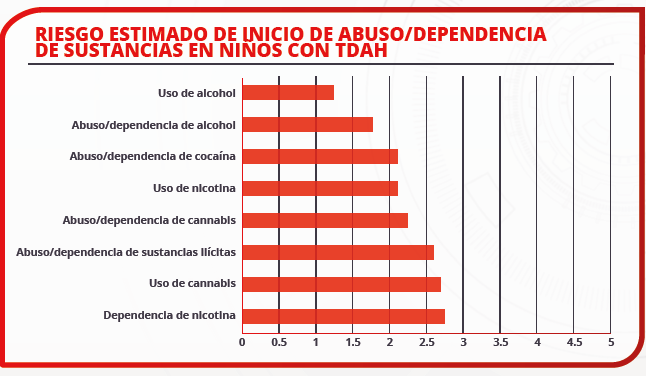
Imagen adaptada de: Lee, S. S., Humphreys, K. L., Flory, K., Liu, R., & Glass, K. (2011). Prospective association of childhood attention-deficit/ hyperactivity disorder (ADHD) and substance use and abuse/dependence: a meta-analytic review. Clinical psychology review, 31(3), 328–341.
Referencias
Referencia(s):
- Crunelle, C., van den Brink, W., Moggi, F., Konstenius, M., Franck, J., Levin, F., van de Glind, G., Demetrovics, Z., Coetzee, C., Luderer, M., Schellekens, A., & Matthys, F. (2018). International Consensus Statement on Screening, Diagnosis and Treatment of Substance Use Disorder Patients with Comorbid Attention Deficit/Hyperactivity Disorder. European Addiction Research, 24(1), 43–51. Recuperado de: https://doi.org/10.1159/000487767
- Harstad, E., Levy, S., & Committee on Substance Abuse (2014). Attention-deficit/hyperactivity disorder and substance abuse. Pediatrics, 134(1), e293–e301. Recuperado de: https://doi.org/10.1542/peds.2014-0992
- Zulauf, C. A., Sprich, S. E., Safren, S. A., & Wilens, T. E. (2014). The complicated relationship between attention deficit/hyperactivity disorder and substance use disorders. Current psychiatry reports, 16(3), 436. Recuperado de: https://doi.org/10.1007/s11920-013-0436-6 4. Lee, S. S., Humphreys, K. L., Flory, K., Liu, R., & Glass, K. (2011). Prospective association of childhood attention-deficit/hyperactivity disorder (ADHD) and substance use and abuse/dependence: a meta-analytic review. Clinical psychology review, 31(3), 328–341. Recuperado de: https://doi.org/10.1016/j.cpr.2011.01.006